

At least one in four South African children are stunted due to chronic malnutrition and one in five households suffer some form of hunger. The South African Human Rights Commission has called this a moral and political crisis given that South Africa produces almost 20% more food than is needed to feed everyone. This month the Commission is holding a National Inquiry into the food systems of South Africa to scrutinise and find solutions to this contradiction.
Child malnutrition is of special concern. A submission to the South African Human Rights Commission (SAHRC) by the Just Transition in the Food System group, notes that this malnutrition includes stunting and wasting due to undernutrition, micronutrient deficiencies and rising obesity (roughly a third of under 19s) due to increasing reliance on nutrient-poor, highly processed foods.
Chronic undernutrition compromises children’s developing bodies and brains in ways that undermine their long-term health and ability to learn and develop, leading to intergenerational cycles of malnutrition, ill health and poverty. Rising obesity is driving an increase in Non-Communicable Diseases (NCDs) such as diabetes, high blood pressure, and liver disease, which are becoming a leading cause of ill-health and death in sub–Saharan Africa.
One of the key government responses to childhood hunger has been the introduction of the child support grant as well as the National School Nutrition Programme.
The National School Nutrition Programme aims to enhance learners’ educational outcomes and health by ensuring access to nutritious meals, integrating nutrition education into the school curriculum, and promoting sustainable food production through school gardens.
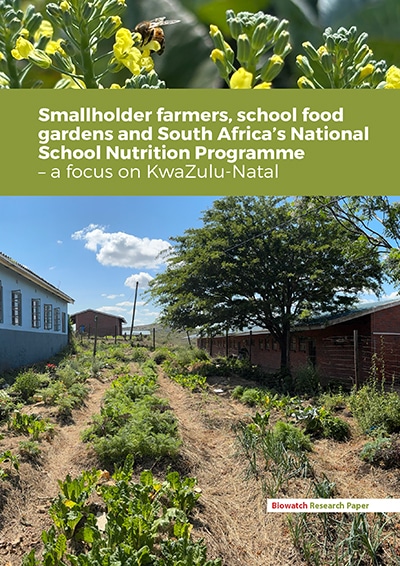
The recently published Biowatch research paper by Sithandiwe Yeni, “Smallholder farmers, school food gardens and South Africa’s National School Programme” explores whether the NSNP is meeting these goals, with a focus on KwaZulu-Natal. It also investigates the extent to which smallholder farmers are involved in the programme and the potential for agroecological produce to be supplied to the programme or grown in school gardens. Examples from Brazil, India and Ghana show that well-structured and adequately funded state programmes enable smallholder farmers to effectively supply schools with healthy, nutritious food. In return, they create local economies and contribute to broader livelihoods through secured markets for their produce.
The paper offers timely learnings as South Africa considers how better to ensure the constitutional right to food for South Africa’s children.
Download the paper here: https://biowatch.org.za/download/national-school-nutrition-programme/